DESIGNING A FINTECH SYSTEM FROM ZERO
The platform that replaced the spreadsheet
COMPANY
Confidential
ROLE
Product Designer
EXPERTISE
Product Design, UX Research, IA, Interaction Design, Design Systems
YEAR
2025
Project description
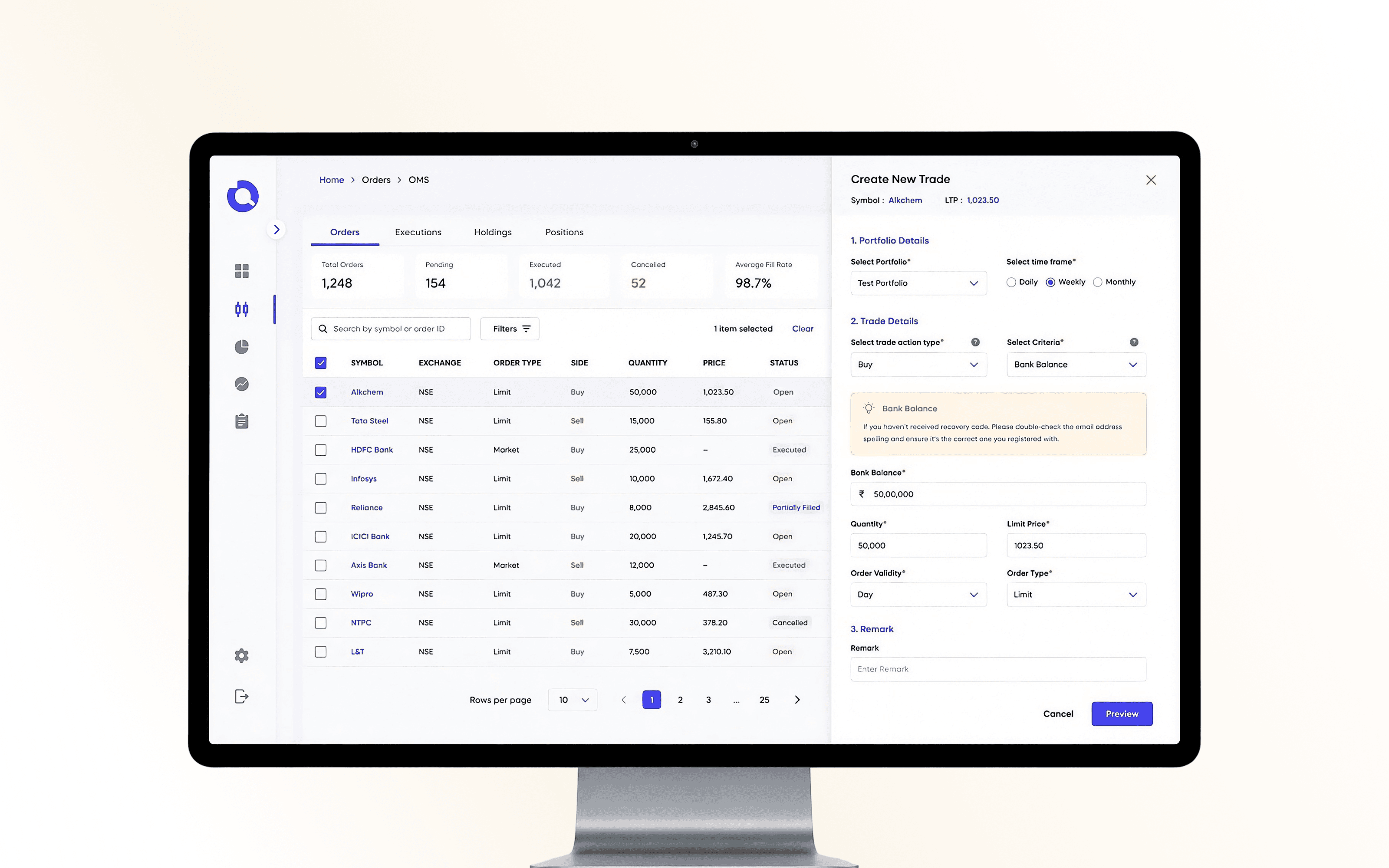
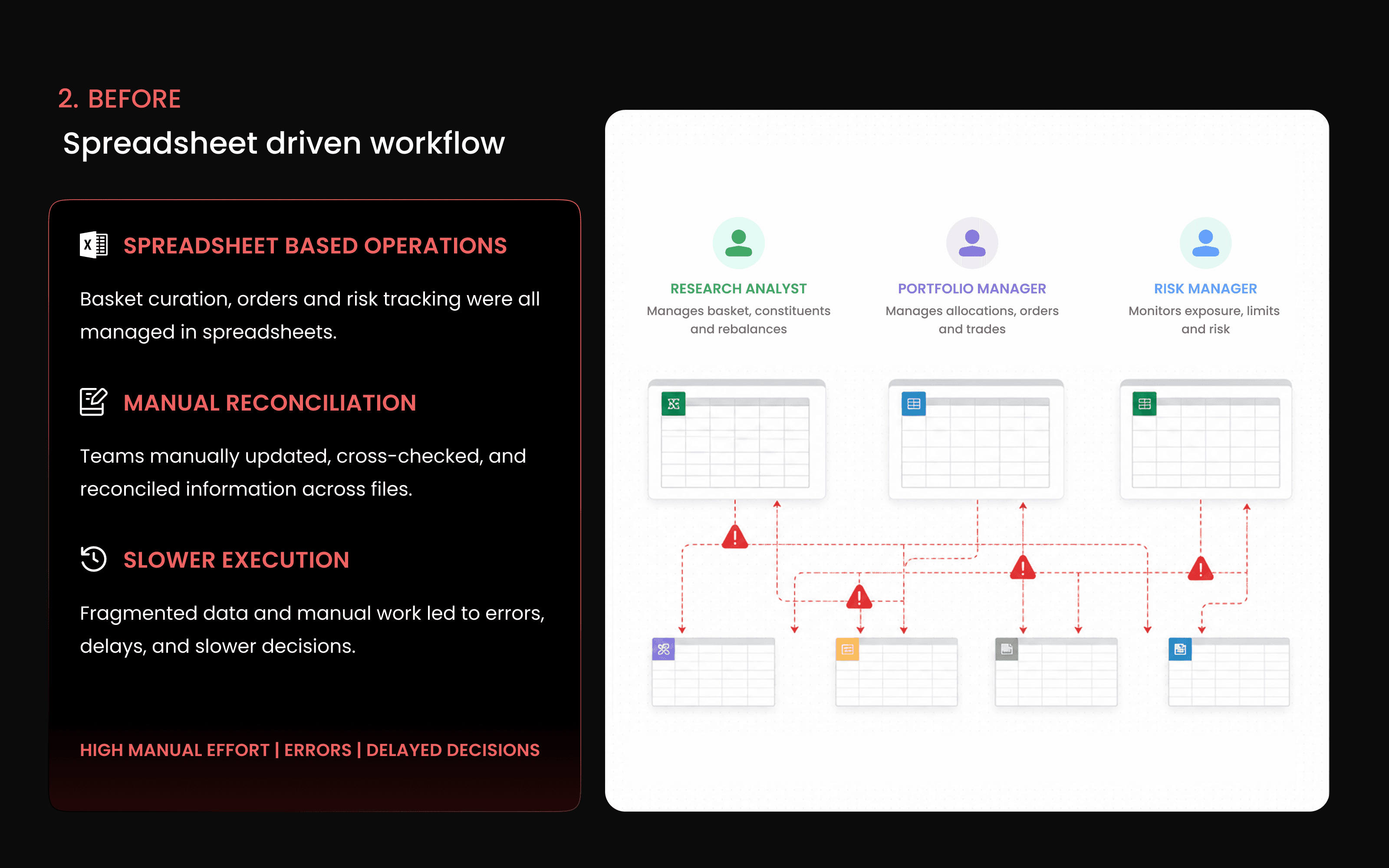
Mid-sized brokers and portfolio-management firms were relying heavily on spreadsheet-driven workflows to manage portfolios, calculate allocations and prepare rebalancing orders across client accounts.
The goal was to replace that fragmented workflow with a connected investment-management platform covering research, order management and risk.
I took the product from early structure and flows through high-fidelity UI, prototyping, design QA and the shared design system across three modules.
Challenge
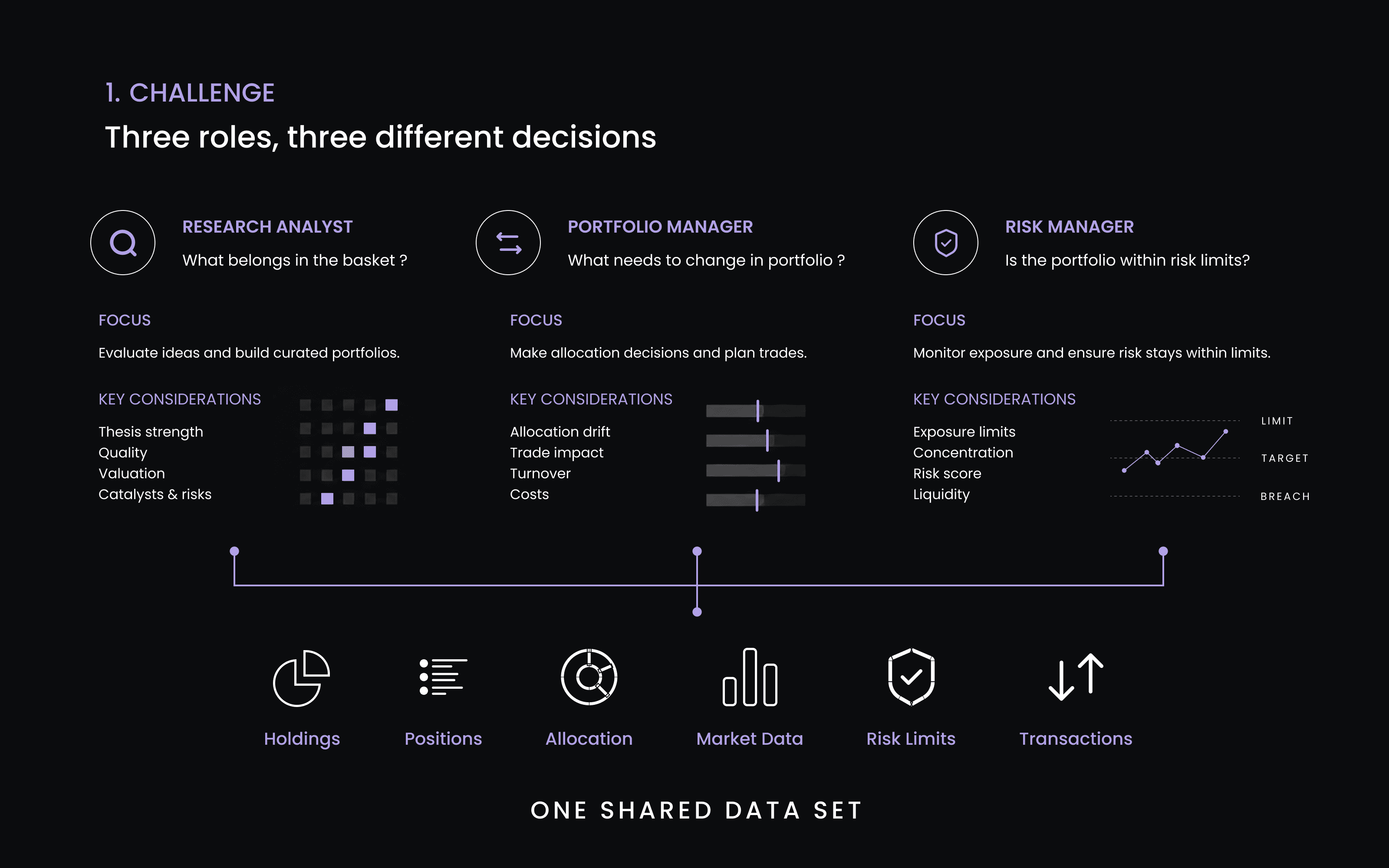
The product had to support multiple roles, three connected modules and dense financial data. The hardest part was not displaying the data it was making the same underlying information useful for very different decisions.
A research analyst evaluates a basket. A portfolio manager decides what needs to be rebalanced. A risk manager monitors exposure and breaches. One platform had to support all three without becoming three disconnected products.
Ways of working I had no prior stock-broking experience, so I started by building a working understanding of the domain and mapping financial concepts to real workflows. I worked directly with the founder and domain expert to understand how brokers and portfolio managers handled these tasks manually.
My ownership covered information architecture, user flows, wireframes, high-fidelity UI, prototyping, design QA and the component system across all three modules.
Process
Designing an unfamiliar financial workflow around how people actually make decisions.
01.Learn the workflow
I built a working understanding of the domain and mapped financial concepts to real workflows, using founder and domain-expert walkthroughs to understand how the work was done manually.
02.Design around decisions
The same data meant different things to different roles. Instead of creating separate products for each user, I designed a shared information architecture with role-specific views, metrics and actions.
03.Scale the system
I established reusable patterns for tables, metric cards, status states, navigation and interactions, then evolved them into a shared component system across the three modules.
The core insight
One data model. Different decision-making views. The platform did not need three isolated experiences. It needed one connected system that changed what the user saw and could do based on the decision they were making.
Design principles
Design for the decision, not the data. Every number earns its place by helping someone understand, decide or act.
Solution
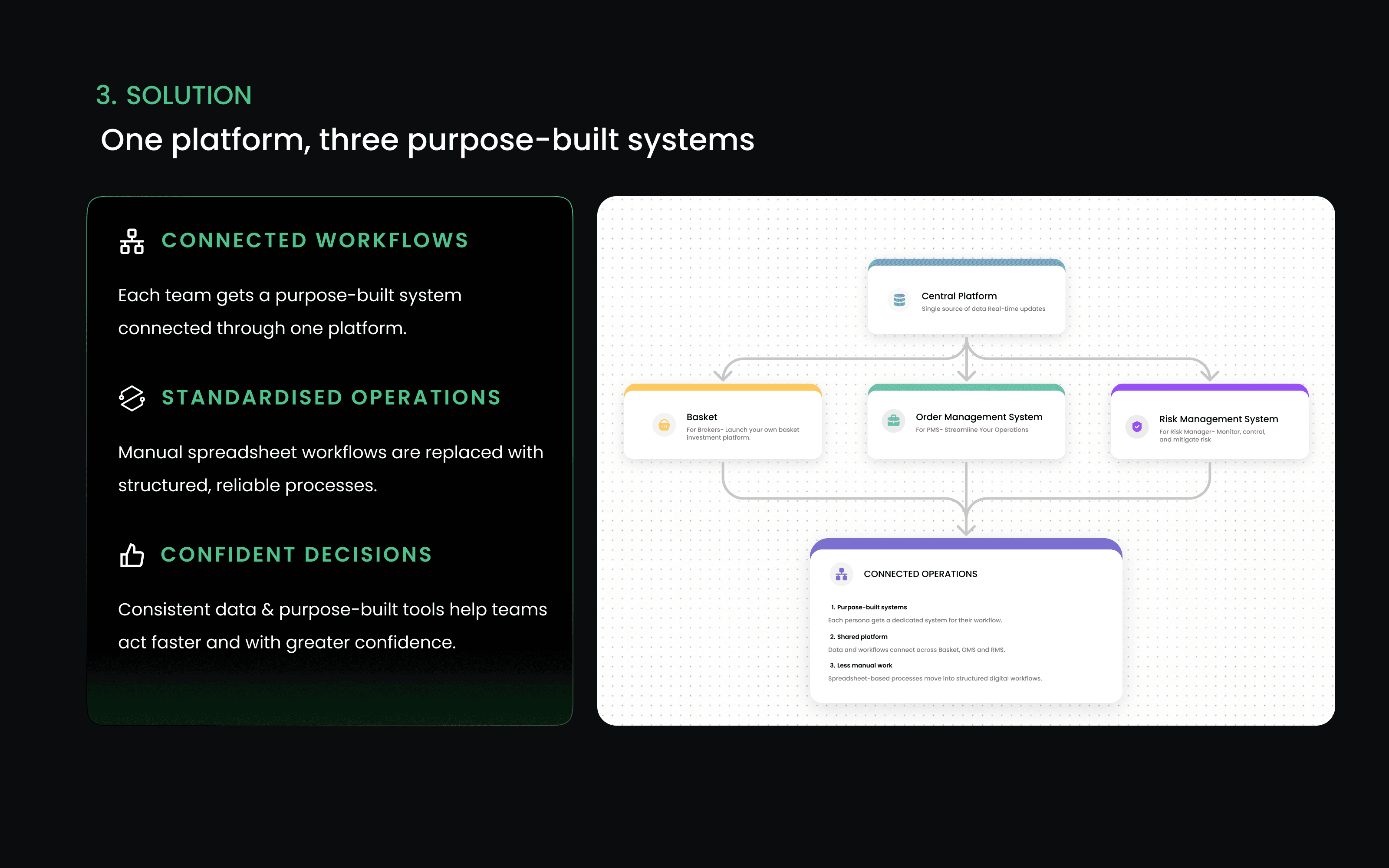
Three connected modules. One shared system.
Three connected modules
Baskets
Research and curated portfolios, including rebalance and portfolio tracking workflows.
Order Management System (OMS)
Portfolio and order management, with rules and guardrails supporting operational workflows.
Risk Management System (RMS)
Risk limits, custom rules and real-time monitoring connected to the order-management workflow.
Role based dashboards
Instead of giving every role the same dashboard, the interface prioritises the metrics, information and actions relevant to the decision being made.
Bulk order preview, before execution
Portfolio managers can review orders across client accounts before execution, reducing the need to move between spreadsheets and disconnected steps.
A rule builder for risk
Risk managers can define thresholds and actions so important exceptions are surfaced through the system instead of relying only on manual checks.
A design system built to scale
A shared component system kept the three modules visually and behaviourally coherent while allowing each workflow to remain role specific.
Results
A platform that didn’t digitize spreadsheets it replaced them.
₹1,500 Cr+ AUM
Assets under management across the platform.
200+ accounts
Portfolio rebalancing workflows handled across client accounts.
Hours compressed into minutes
Spreadsheet-heavy portfolio workflows were compressed into system-generated steps, including allocation and order preparation.
From reactive to proactive
Risk monitoring moved toward continuous visibility through thresholds, rules and real-time monitoring.
What I'd do differently
I would push for direct access to end users earlier. Founder and domain expertise helped me understand the workflows quickly, but direct conversations with brokers and portfolio managers would have sharpened the product decisions further. I would also formalise the design system earlier; evolving it organically worked, but it became more important as the third module took shape.